Back-to-School Transition Tips: How to Start the School Year Smoothly
The short answer: A smooth back-to-school transition comes down to six things — building the daily routine with your child, setting up teacher communication before day one, refreshing organizational systems for the new grade level, learning school procedures early, prepping simple breakfasts and lunches, and signing up for fewer activities than you think you need.
The Brief

Getting into the school-day routine takes time and patience, especially when your child is acclimating to a new educational environment
Set up communication with teachers early and check on school and class procedures
Establish simple meal prep for easy breakfasts and lunches
Avoid overload by not over-scheduling sports, activities, and after-school extracurriculars
Back-to-school season is in full swing, and parents are focused on getting children into the flow of the new school year. Below are the tips we share most often with families to prepare both you and your child for a successful start.
How do you help a child transition back to school?
Start roughly one to two weeks before the first day. Shift bedtimes and wake times gradually, rebuild the morning sequence, and talk through what the school day will look like. Then layer in the practical systems — communication, organization, meals, and activities — so the first week isn't the first time anyone tries them.
A few anchors worth setting before day one:
Sleep. The American Academy of Pediatrics recommends 9–12 hours of sleep for children ages 6–12 and 8–10 hours for teens ages 13–18. Adjust bedtime in 15-minute increments rather than all at once.
Routine. Build it collaboratively, not unilaterally (more on this below).
Communication. Know how your child's teacher prefers to be reached before you need to reach them.
Organization. Assume last year's system may not fit this year.
Meals. Decide on three or four repeatable breakfasts and lunches.
Activities. Start with one or two, and scale from there.
Find your flow: build the school-day routine with your child
Getting into the school-day routine can take time and patience, especially with little ones acclimating to a new educational environment.
Routines for elementary students
One of the easiest ways to ease the transition is to get your child involved in building the routine. Ask them what they want to include. Perhaps they want time for reading before dinner, or a snack break before starting homework. Your child's input gives them ownership of the process and helps you settle into new rhythms with fewer hiccups.
For the youngest students, assigning different responsibilities throughout the day can turn parts of the routine into something to look forward to, which helps the whole day run more smoothly.
Routines for middle and high school students
Be a sounding board for your teen's rhythms and routines, but remember they're old enough to start finding their own flow. Tweens and teens need opportunities to experiment with how they manage homework, activities, sleep, screen time, and other responsibilities.
Instead of building every system for them, ask questions:
What part of your routine is working?
Where are you getting stuck?
What would make this easier?
Encourage teens to develop systems that fit their schedule, personality, and priorities, while you provide support, structure, and accountability when needed. The goal isn't to manage every detail — it's to offer guidance so they cultivate a routine that actually works for them.
Set up communication with teachers before the first day
Asking the right questions early saves a lot of time and confusion later. Before or during the first week, find out:
Does the teacher prefer email, or is there a portal where communication takes place?
Is there a weekly newsletter?
Does communication come from school administration or from teachers directly?
What's the expected response time?
Finding the best way to communicate is essential to starting the year off smoothly.
When to step back for older students
For middle and high schoolers, the majority of communication should stay between your student and their teacher. Encourage them to ask questions directly and to determine the best way to reach each teacher. Step in as needed, but keep in mind that students at this age need to build self-advocacy skills — and independently communicating with teachers is a great place to start.
Establish or reassess organizational systems
Setting up an organizational system at the start of the year helps your child build a rhythm of keeping up with assignments, marking important dates, and staying on top of deadlines. An organized workspace matters just as much.
Keep in mind that what worked last year may not work this year. Whether your child is changing schools, switching to homeschool, or moving up a grade level, the systems may need to change with them. Older students and teens may rely on Google Workspace, while younger students often do better with a traditional paper planner.
Assess with your child which systems their teachers use, and if there's no set preference, talk through how they want to keep everything on track.
Check on school and class procedures
Does the school have an app? A parent portal? How is basic information communicated? Set up whatever systems you need before school begins so you're ready for anything sent out on the first day.
Simplify breakfast and lunch preparation
A constant source of stress for many families is preparing simple, healthy meals for on-the-go mornings. A short rotation of repeatable options goes a long way:
Make-ahead breakfasts save time during the morning rush
Lunchbox-ready lunches take the guesswork out of what to pack
A set weekly rotation removes the daily decision entirely
These work for children of all ages and are especially useful on busy mornings.
Choose after-school activities without overloading the schedule
There's a lot to weigh when deciding which sports, clubs, and activities to sign up for. Err on the side of caution and commit to fewer activities than you think you can handle.
Consider signing up for just one or two, see how your child does, and scale up or down from there. During such a busy season of newness, be mindful of not overloading your child — or yourself — with too many time commitments.
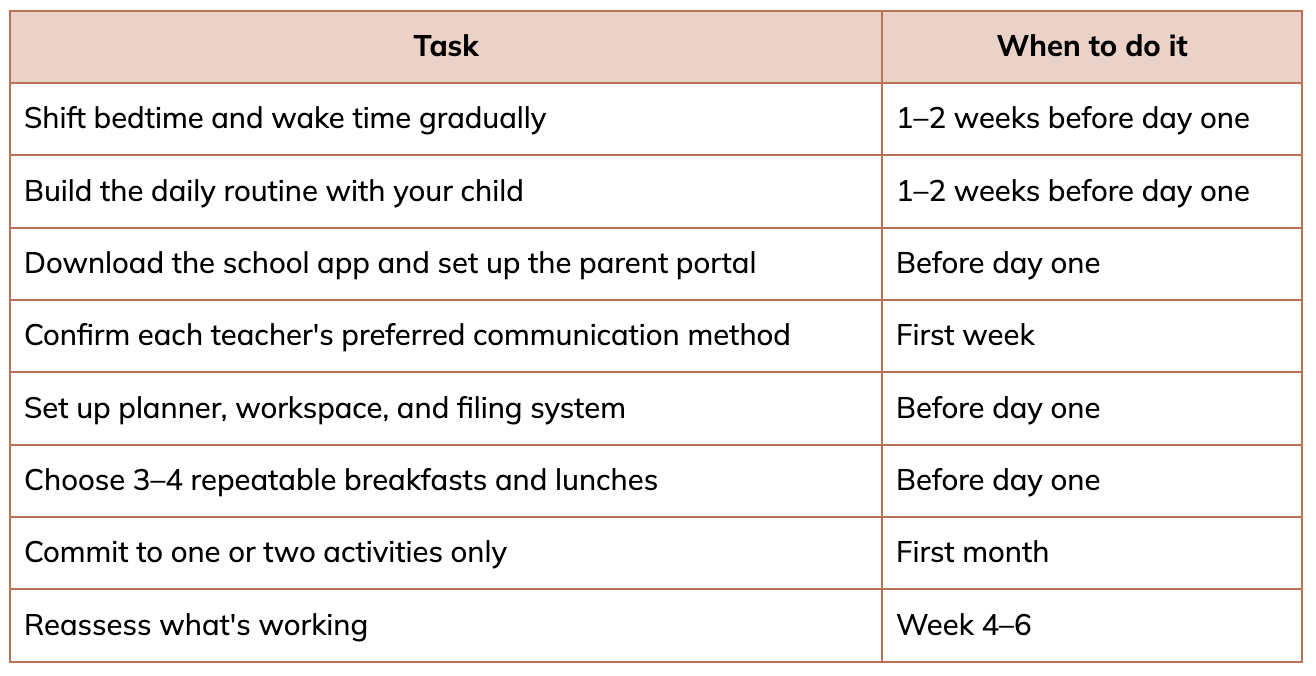
Back-to-school transition checklist
Frequently asked questions
How long does it take a child to adjust to a new school year?
Most children settle into a new school year within a few weeks, though children starting at a new school or a new grade level often need longer. If your child is still showing significant distress after four to six weeks, it's worth checking in with their teacher or school counselor.
When should we start the back-to-school routine?
One to two weeks before the first day is a good target. That gives you enough time to shift sleep schedules in small increments and practice the morning sequence without cramming. But if you are well into the season, you can always start now!
How much sleep do school-age children need?
The American Academy of Pediatrics recommends 9–12 hours per night for children ages 6–12 and 8–10 hours per night for teens ages 13–18.
How many after-school activities should my child do?
Start with one or two and adjust from there. Beginning with fewer commitments lets you see how your child handles the workload before adding more, and it's much easier to add an activity mid-year than to drop one.
Should parents email teachers directly in middle and high school?
Generally, no. Most communication should go directly from your student to their teacher so they build self-advocacy skills. Step in for larger issues — accommodations, persistent conflicts, or anything requiring a parent signature.
What's the best organizational system for students?
It depends on age and on what the school uses. Teens often do well with digital tools like Google Workspace or Google Calendar, while elementary students typically benefit from a paper planner and a consistent, organized workspace. Match the system to what your child's teachers already use where possible.
Making the transition a little smoother
With all the change a new school year brings, a few simple additions to your family's routine can make the transition noticeably easier. As always, your TPL concierge team is here to support you in navigating this time of year.
Happy back-to-school season!
Kristen Powers writes on educational transitions for TPL. Kristen Powers is a former classroom teacher with over eleven years in education, specializing in math and supporting neurodiverse middle and high school students. She holds an M.Ed. in Math Curriculum & Instruction from the University of Texas, an M.Ed. in Elementary Education Teaching from Lesley University, and a professional certificate in College Admissions for Emerging Leaders from NACAC.